-
Microsoft really wants to make it expensive to stay on XP. One way to make the TCO look better is to jack-up the cost side of staying on XP.
As I read Who’s Got Your Back: The Breakthrough Program to Build Deep, Trusting Relationships That Create Success–and Won’t Let You Fail
Jim Cartwright invested may hours in my success, an investment that has delivered to me returns in multiples I am unable to measure. Like most teenagers, I failed to understand the value of his investment when it was being made. I will never forget how far his loyalty extended, I was in my last full year in collage when my father passed away suddenly without warning. I was in St. Louis and had to fly back to Chicago, who was there to pick me up 4 years after I had wrestled for him Jim Cartwright and Fred Arkin. I will never forget that small but meaningful gesture, it meant a great deal to me. For the time, effort, training, prodding, swearing, and advise, I owe more than I know to Jim Cartwright.
Without Jim Cartwright having my back I would not be where I am today.
-
Some interesting numbers. I especially like the Dell stats and the Google Enterprise numbers.
-
Great bullet point over view of Google I/O 2009. The cow paths have been paved and common rules of the road have increased the velocity of change on the "interpipes". Big wave on the horizon get ready to surf or drown.
-
Seth Godin makes a great distinction between Luxury and premium. The funny thing is customers are clearly more capable at determining the actual value of a premium product. This means that companies are going to have to really focus on their value proposition and know that premium will have to translate into real value.
-
Go buy your art work and blank CD.
-
A good article by Jim Collins discussing how leading companies/countries fall from a position of leadership.
Over the past 5 years more and more companies have found value in the data already in their possession. Companies like Walmart have used data collected to create a competitive advantage, enabling them to dominate their industry. Google is a business founded on the value of data and clearly has set the standard for monetization of data. Even with the data revolution sweeping the business world many business fail to understand the opportunity that sits locked in the applications that run their businesses. Even more disturbing is the data that is never collected due to the limited view of what constitutes a valuable company asset.
In simple terms companies without a comprehensive data collection and monetization strategy will continue to underperform competitors with more forward looking data strategies. Companies without a data collection and monetization strategy will typically view their data in silos, like pricing, supply chain, customer and marketing. Companies without a data collection and monetization strategy may also lose data due to aggressive data retention policies, born of fear and risk management. As the cognitive economy becomes a reality, companies with their silo views will not be competitive and hemorrhage market share to their more informed competitors.
-
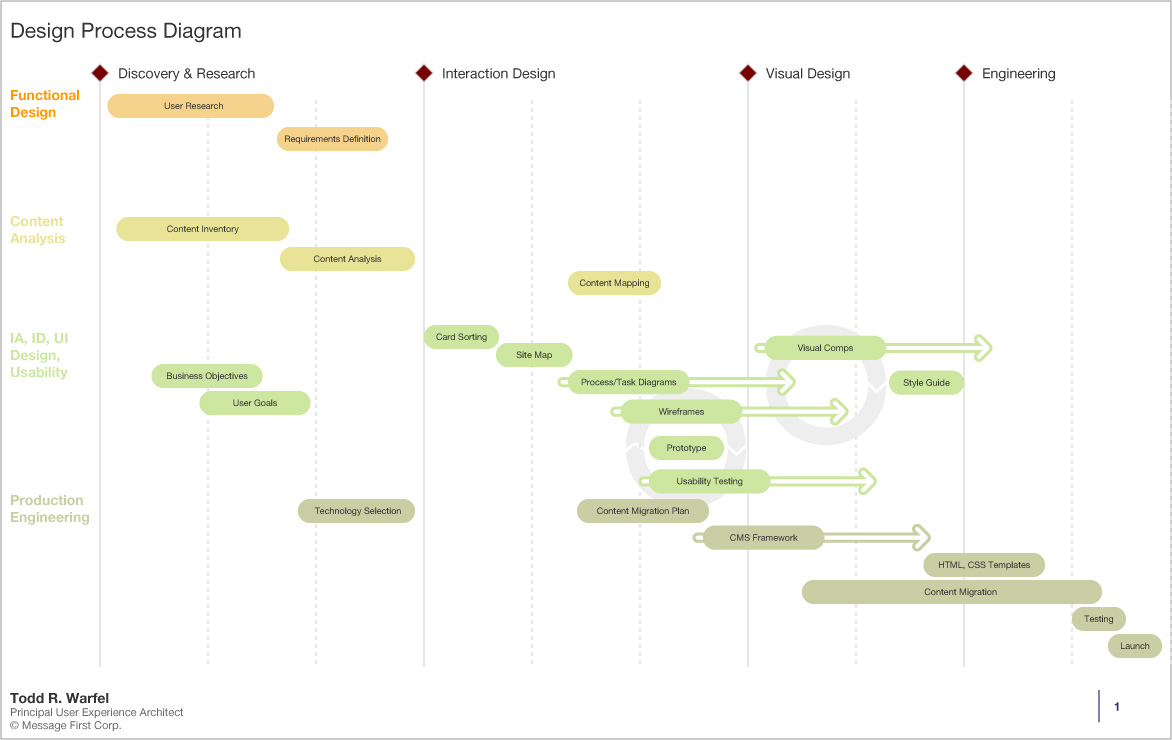
A well laid out diagram of the process of design
-
Google's list of guiding principles.
-
Great brief articles to get you thinking.