Attention and Gestures require an honest broker

In information centric economies, value is a function of trust. The role of the honest broker is to provide a well understood and transparent point of reputation for attention and gesture information. The information economy we see growing around links and clicks is driven by the reputation of a few silos in the economy. Google, eBay, Yahoo and Microsoft are major reputation providers in the link/click economy. I would never call any of these parties honest brokers, though some are closer to honest broker than others. These reputation providers are by no means neutral and each defends their reputation silo fiercely from competition. That defense can make the reputation less accurate as it is never clear where the interests of the provider end.

In the Attention Gesture information economy an honest Broker is required to facilitate the exchange of and valuation of information. Similar to financial scores, the honest broker provides the unadulterated reputation of an attention/gesture provider allowing the attention/gesture consumer to value the information and then provide the attention provider with some sort of value. The honest broker never has a hand in determining the value of the transaction, but by ensuring that reputation of the provider and consumer are well known to both parties it ensures that each party can trust the valuation. The honest broker provides reputation for both attention/gesture providers and consumers, allowing both parties to identify the value of the attention data.

This honest broker service might be free as part of a network collaboration or it may be a fee for service model similar to credit card industry. Regardless, an honest broker is required to defend the attention/gesture pools from fraud and hijack. The honest broker will become a mechanism for maintaining experience continuity across a long running set of interconnected actions and exchanges, in a life connected.

As we move from an attention economy to a situational awareness economy honest brokers will be woven into the fabric of our online cognitive models.

RSS feed Fixed

I have received some complaints (Angry Penguin) about my RSS feed only sending article summaries. I just want to clarify that I wasn’t trying to force people to the site, it was just an oversight on my part. It was a simple config change in wordpress. I hope the new config makes your subscription a bit more enjoyable.

Testing Gmail for my Domain

I was granted access to the Gmail for Domains beta. The set up was extremely simple, but I still don’t think that a non geek will know what their MX record is. Adding accounts is a snap and the calendar integration is wonderful. I am now wondering how much it will cost for multiple domains. I have multiple domains and would like to manage all my email account for my whole family via Gmail without setting up forwarding. Google definitely has the email interface down. It works great and I love the way email threads are handled. If Google can provide a few more tools, there will be no reason to buy office. Google will have a completely integrated set of office web applications that are completely portable. I won’t have to worry about backing up anything or getting updates and security patches.

Corporations would be well served by a tool like Gmail for domains. Corporations have to get around and over the control issues, if they do Gmail is a no brainer. For companies with large field operations again it’s a no brainer. It’s only a matter of time.

I give Gmail for Domains 5 out of 5 Stars.

Links:
Gmail for your domain

Experience Continuity

I have been thinking about how companies build systems. In my experience the companies focus on the things like business continuity and leave for last (if they are lucky) experience continuity. The systems are reliable, transactional, scalable and redundant but yet from the outside the system seems a bit off. The systems are build to reflect the desires of the company and in many cases the customer perspective is the lip stick on the pig. In the end who cares if the system is sound and provides for business continuity, if it fails to provide experience continuity. Doing the wrong thing the right way is still doing the wrong thing. Experience continuity is the starting point and the rest will take care of it self.

More than a product offer, It’s attention efficiencies and products

Traditional companies (manufacturers or any one in the classic supply chain) will be faced with competition for their customers attention. A company today strives to spend the majority of its attention on its differentiating value. That means GE doesn’t think how it buys pencils is a differentiating value. The attention that GE wishes to spend on those non-differentiating items is small and getting ever smaller. The funny thing is the attention efficiency GE seeks from its suppliers is in some cases the efficiency GE’s own customers are seeking.

So what does a company like GE do to meet the customers desires, it offers its customers the opportunity to spend less time managing the domain that GE’s products and services are applied in. For example, GE may build custom fuses for power plants but that is not the real value. The real value is ensuring that a fuse failure doesn’t take the plants production capability off line. What GE could provide the customer is an attention efficiency around monitoring a plant’s distribution network, coupled with a highly integrated logistics capability, and a ready supply of power distribution products. GE becomes the Tivo of power distribution, identify the parameters of need, set it and forget it. The attention that GE set free can be applied elsewhere. That attention efficiency doesn’t mean it costs less, though it should. It means that the company trades unskilled dollars for talent that can be used to improve revenue making operations.

More and more companies are going to be required to deliver more than a product, they will have to deliver a product wrapped in an attention efficiency.

Note:
The GE example is just for illustrative purposes.

Attention efficiency

I think that the attention economy is best served talking about Attention efficiency.

Attention efficiency is the ratio of useful, valuable, or effective output to the total attention input in any system or systems.

For example, the attention efficiency of television changed a great deal when Tivo arrived on the scene, reducing the required input to get the same value. To deliver on the attention economy is to deliver attention efficiency. If managing Tivo consumes the same amount of attention as the eliminated commercials then Tivo has done nothing to deliver attention efficiency (not the best example, but its late). So as attention becomes the measure of value then we must understand what burdens our applications and businesses place on the attention of our customer / users / observers.

Today we lack any real attention efficiency due to the fact that we are required to interact in so many different silos. I like to think that we will move the online experience (offline experience will slowly disappear) from one of silos that force attention inefficiencies, to a paradigm of situational awareness that is driven by creating attentional efficiencies based on our individual values.

It is critical to point out that the folks who think about attention are themselves early adopters and forward thinkers, that is not the case for everybody else. So our success is dependant on folks that don’t think about attention but value it and desire simple means to deliver more effective output from their attention investments.

Links:
The definition of efficiency courtesy of Answer.com
efficiency

Most Popular Books at Java one: Update

.flickr-photo { border: solid 2px #000000; }
.flickr-yourcomment { }
.flickr-frame { text-align: left; padding: 3px; }
.flickr-caption { font-size: 0.8em; margin-top: 0px; }


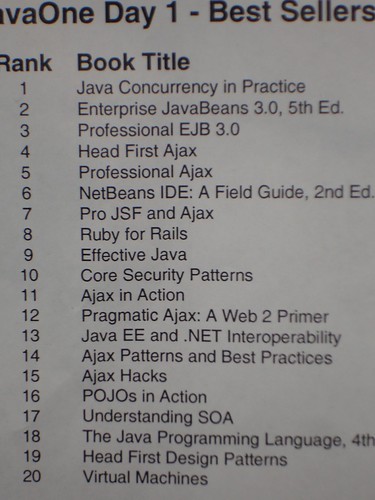
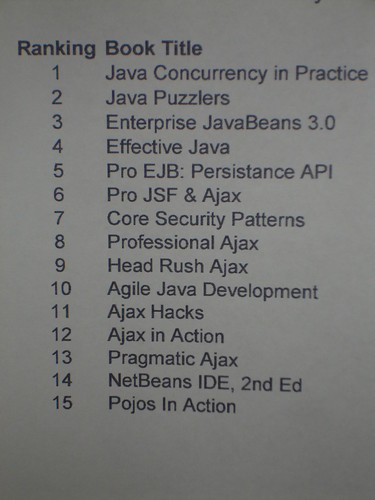
I thought I would update the list of best selling books at JavaOne. It was sad to see Ruby for Rails drop off the list. Looks like AJAX was a popular topic, taking 6 of the spots on the list.

Links:

Most Popular Books at Java one, originally uploaded by TomC.

JavaOne Highlight: Meeting Adam and Jamie from Mythbusters

.flickr-photo { border: solid 2px #000000; }
.flickr-yourcomment { }
.flickr-frame { text-align: left; padding: 3px; }
.flickr-caption { font-size: 0.8em; margin-top: 0px; }


The After Dark party at Java one featured the Mythbusters. I really enjoy the show, so getting to meet them for a brief moment was way cool. They really liked the winning t-shirt launcher. The party was cool loud pounding urban techno with a cool light show.

James Gosling should let Adam and Jamie build a t-shirt cannon for next year. The entrants would then compete against Adam and Jamie for longest throw and most radical design.

Links:
At the Mythbusters Toxic waste Bar at the party at JavaOne, originally uploaded by TomC.

The winning t-shirt launcher

The Mythbusters