I have been thinking about how companies build systems. In my experience the companies focus on the things like business continuity and leave for last (if they are lucky) experience continuity. The systems are reliable, transactional, scalable and redundant but yet from the outside the system seems a bit off. The systems are build to reflect the desires of the company and in many cases the customer perspective is the lip stick on the pig. In the end who cares if the system is sound and provides for business continuity, if it fails to provide experience continuity. Doing the wrong thing the right way is still doing the wrong thing. Experience continuity is the starting point and the rest will take care of it self.
Category: Technology
.flickr-photo { border: solid 2px #000000; }
.flickr-yourcomment { }
.flickr-frame { text-align: left; padding: 3px; }
.flickr-caption { font-size: 0.8em; margin-top: 0px; }
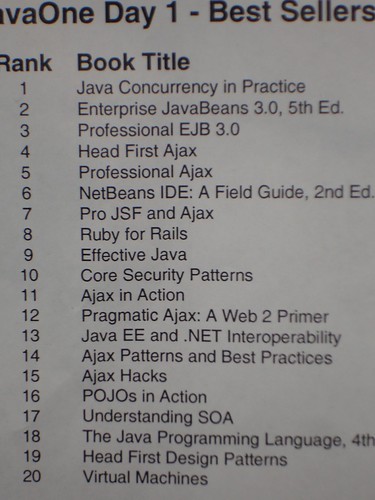
It is funny at JavaOne to see the 8th most popular book. I was in sessions where people were asking what Ruby on Rails was.
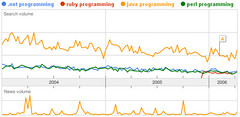
I thought I would try out Google Trends and compare popular programming languages. It appears that Java is still the big dog. Ruby came out of nowhere according to Google Trends. Click on the image to get a larger version.
Links:
Google Trends
Originally uploaded by TomC
As I think more about the economics of Attention I am struck by the silos. Everyday of my life my attention is disrupted by the constant silo switching. I spend 2 to 2.5 hours per day driving to my place of employment. Today, that time is better spent thanks to my self programmed iPod. There exists a huge problem maintaining the flow of information into and out of my commute silo. I have to spend time to deliver information into that silo and its a pain in the neck, sync, plug in, navigate, unplug, plug in navigate, and unplug every day. So here is what I think would be nice.
In the evening as I review my schedule for the next day, iTunes detects my car as a device on my wireless network. iTunes updates my car with the content I have added and allows me to program my drive to work with content. My calendar also detects my car as a device on my wireless network (or as a client via EVDO, a nod to Steve Gillmor) my temporal data gets downloaded and is used to prime my navigation system. The car then could make suggestions regarding when and where to get gas based on price, route changes based on live traffic data, and provide access to my voice mail. The opportunities are all over the place. Why can’t I sync my contacts in Google or yahoo bidirectionally with my cell phone.
Creating attention efficiencies for people in their daily lives is just obvious. Jon Udell writes about the broader value of attention efficiency and effectiveness [1]. Technology has consistently increased the productivity of the individual within the context of a specific task. How about life productivity, how about increasing the continuity of experience of my life, I would be willing to pay for that. In the end, all the players (companies, customers ect..) will have to focus on collaboration, continuity of experience and increased situational awareness.
Links:
[1] Attention economics: by Jon Udell
Comments are now being auto moderated via Sxore. I saw Dick Hardt present on identity 2.0 at Web 2.0. I thought the presentation was really interesting. So as I update the site, I decided to add Sxore comment moderation. So if someone ever comments I can tryout Sxore. So let me know what you think.
I have been planning a personal project and have been thinking about development platforms. I thought about Java and it’s just a bit much, entertained the idea of .NET and it’s too Microsoft and then I looked at Rails. I am a big fan of 37signals and the applications they have built on Rails. So I started messing around and I’m finding Rails to be really well thought out. Ruby is a great language and provides all features I need to build my little project. Rails is very friendly from a development, testing and design perspective. If you need a good book on Rails try Agile Web Development with Rails by Dave Thomas and David Heinemeier Hansson with Leon Breedt, Mike Clark, Thomas Fuchs, and Andreas Schwarz.
Jon Udell had a really interesting post detailing the number of Virtual Machines that reside on his various computers. I agree it would nice to see Sun increase its support for development of other languages based on the Java VM. I attended JavaOne in 2004 and there was a session on Groovy. I’m not sure that Groovy has been widely adopted and that Sun is willing to invest in taking the Java VM into the multi-language arena. Microsoft on the other hand seems to be ready and able have .NET be the multi-language VM of choice. I would think that Microsoft would be the choice to win the non-windows .NET VM competition. Thinking about it a bit more there are a large number of people that would prefer Mono just because its not directly from Microsoft.
I have put together a screen cast of web sites that are moving to increase the continuity of experience for their users. As the web continues to mature, the lines between local applications and web applications are going to slowly disappear. Companies Like Google, Amazon, Yahoo, and others are making it clear that web applications are no longer going to be the lesser cousin to desktop applications. Enjoy.
I have now had the opportunity to mess around with IE 7 beta 2 for a week or so. Here is a list of things I like:
- The new tab button that makes opening a blank tab very click-able.
- The clean tool bar design.
- Simply supporting RSS
- The Tab Grid View
I read someone comparing IE 7 vs. Firefox to IE vs. Netscape. I am still a loyal Firefox user but again Microsoft is working hard to remove the functional differences between the two. It has been a long wait for IE 7 but It seems that it won’t disappoint the average user. The IE Blog has been an interesting read.
I finally have installed Google Analytics. What can I say I just wanted to try Google Analytics out. I was also real lazy and used the Google Analyticator plug-in. It was easy as 123. Now I can track the mass of people that stop by to see how long it has been since I updated last.
I wonder if the there are more robust versions of the plug-in underway, maybe from Google. Sounds like a great summer of code project.
 Tom The Architect